Genesis GV80 Review (2021-present)
Genesis GV80 cars for sale
3.0
Expert review
Pros
Promise of hassle-free customer service
Roomy and plush interior
Luxurious standard equipment
Cons
Not as sharp to drive as a BMW X5 or Porsche Cayenne
Lacks an electrified powertrain
Uncertain resale values

The CarGurus verdict
The lack of an electrified powertrain, or even simply a more efficient petrol or diesel engine, is an issue with the GV80. But by any measure this is still an intriguing and promising start to a new premium brand in Europe. The Genesis GV80 offers comparably good value for money, it feels sumptuous to drive and spend time in, and it has an appealing sense that it’s trying to be a bit different to the norm. If the promises of time-saving, hassle-free and personalised customer service prove to be true, that could also be a big incentive.
So, should you buy a new Genesis GV80? At this point it’s still a hard one to justify objectively. But, with the might of Hyundai at its back and a bevy of new models – electric and otherwise – already on the cards, this new premium Korean brand could be on its way to unsettling the likes of Audi, BMW, Lexus, Tesla and Mercedes.

The Genesis GV80 SUV is the beginning of a whole new luxury brand in Europe and the UK. Genesis is the premium arm of Hyundai; it’s been in existence since 2015 and already sells cars in South Korea, the USA, China and various other markets, but 2021 marked its first official foray on to British shores.
The GV80 is Genesis’s answer to the Audi Q7, Volvo XC90, Lexus RX and BMW X5. It’s a large, all-wheel-drive, luxury SUV that’s offered with either five- or seven seats. Currently it’s only offered with a 2.5-litre petrol engine or a 3.0-litre diesel, both with an eight-speed automatic gearbox and active four-wheel drive. Under the skin, the GV80 is based on a modified version of the platform that underpins the brand’s G80 saloon.
An electric variant is a possibility, but nothing’s confirmed yet. There will, however, be a full electric version of two other cars, the G80 saloon and GV70 SUV, plus the GV60, which is a bespoke EV based on the Hyundai Ioniq 5 and Kia EV6.
If the Genesis name seems familiar (and yes, we know it’s also the name of the Phil Collins-fronted band), then it’s because Hyundai has already used it for a luxury car, toe-in-the-water exercise a few years ago. The badge was affixed to the boot and bonnet of a large four-door saloon that promised Mercedes S-Class space, luxury and technology for less than the cost of an E-Class. It was loaded with equipment and came with five-years free servicing, but a thirsty 3.7-litre V6 petrol engine, lacklustre driving dynamics and cut-price image meant it disappeared without a trace.
The Genesis GV80 is a seriously comfy place to sit, with a high-set driving position that’s more reminiscent of a Range Rover or Land Rover Discovery than a BMW X5. Everything feels well put together and the materials look and feel classy, although – in the entry-level Premium Line car - it’s let down a little by some scratchy plastics in key areas around the drive mode- and gear-selector switches, and some of the switches don’t feel as well damped as you’d hope.
The rather lovely pale wood finish in Luxury Line cars goes a long way to making the GV80 feel closer to its rivals for quality and boutique interior style lustre, although even then there are some of the switches and materials in key areas that aren't as good as you'll enjoy on an Audi or BMW. Still, at least there’s plenty of storage, with cupholders galore, a deep lidded centre armrest cubby and handily-sized door bins.
There will certainly be no complaints from passengers about the space on offer, with those in the middle row getting plenty of space to stretch out. You can also add a rear entertainment pack with individual screens for the kids, but in reality the £2,280 cost of that option makes a pair of new tablets look like a savvy move instead.
Available as an option is a third row of seats, which can be raised or lowered from the boot floor at the touch of a button. Climb aboard and you’ll discover there’s a little less space for legs and heads than a Land Rover Discovery, but adults will be fine for short hops and kids will happily spend hours back there.
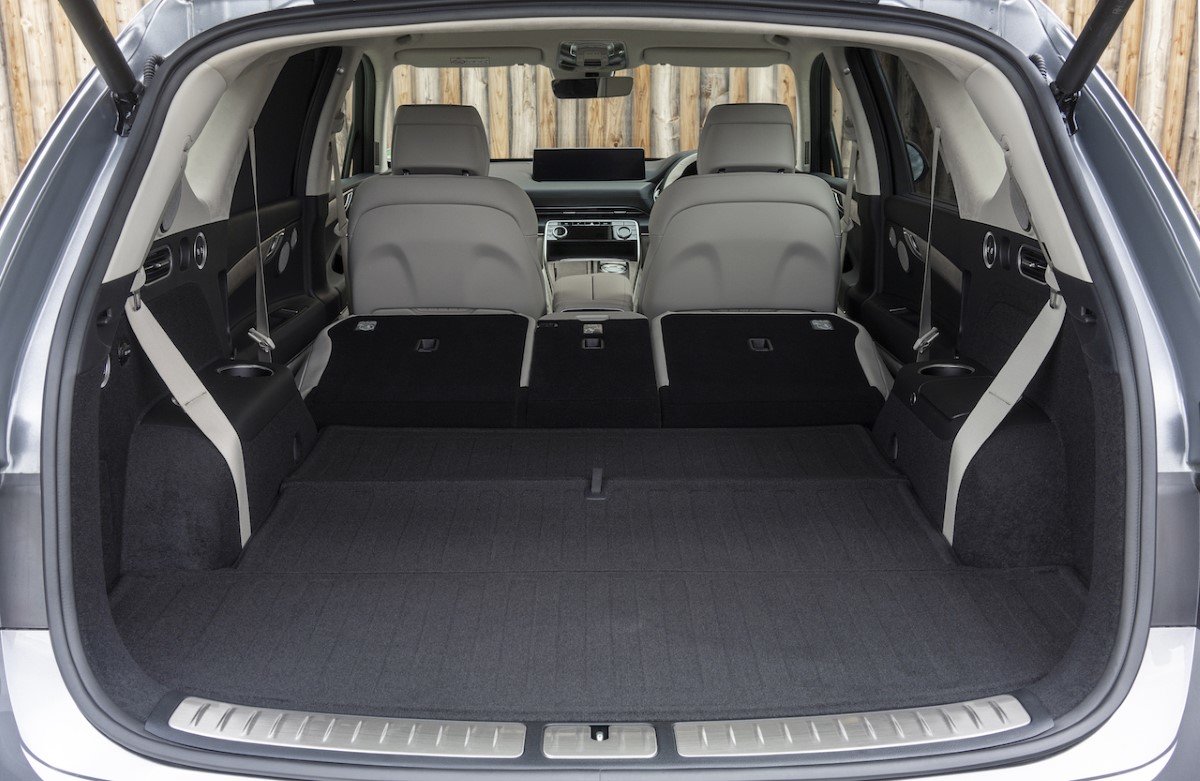
Boot space is equally generous, and with the optional third row of seats stowed there’s a very generous 727 litres of luggage capacity to play with. Better still, the second row has a handy 40/20/40 split for enhanced flexibility and when all are lowered there’s a vast 2,144 litres on offer. The five-seat models are even more accommodating, with 735- and 2,152 litres in each configuration, respectively.
Both the petrol and diesel GV80 models are capable of towing an impressive braked limit of 2,722kg, although this still falls short of the 3,500kg offered by many rivals, such as the Land Rover Discovery and Audi Q7.

The GV80 is as plush as you’d expect when it comes to the driving experience. The 274bhp 3.0-litre, six-cylinder, in-line diesel is smooth, and the 0-62mph time of 7.5sec feels just the right side of acceptable in a car that’s big enough to have its own postcode (even if many rivals offer better straight-line performance). We've tried the 300bhp 2.5-litre petrol engine in another model, the G80 saloon, and while it’s slick and pleasant to drive, we reckon the diesel will fit the GV80’s character better.
The automatic transmission could be a little snappier, however. During unhurried progress it blurs shifts nicely, but it's slow to kick down a gear if you ask for a burst of acceleration. Paddles on the steering wheel give more control, but to be fair, the GV80 just doesn't feel like the kind of car that you want to drive aggressively anyway.
From the moment you set off, the Genesis GV80 creates a calm and stress-free atmosphere, with very little of the sporty edge you’ll find in the sharper-handling BMW X5 and Porsche Cayenne. Everything from the fairly loose body control and light but easy-to-judge steering leans towards a laid-back attitude.
So it’s a little frustrating that the ride comfort doesn’t match the zen-like ambience you’ll find elsewhere in the Genesis GV80. On the standard 20-inch alloy wheels and adaptive suspension of our test car, and despite a camera-based system that reads the road ahead and adjusts the suspension accordingly, the GV80 feels busy over scruffy town roads. Even at higher speeds, mid-corner bumps and ruts send a heavy thump through the car. It’s a lovely, serene motorway cruiser, but in all other respects it doesn't have the supple ride comfort to match the otherwise easy-going character.

There are only two trims available on the Genesis GV80; Premium Line and top-spec Luxury Line. Both are stuffed with features, including a powered boot lid with handsfree opening, keyless entry and 12-way powered front seats with leather upholstery, as well as LED headlights and all the usual convenience features you’d expect.
Luxury Line steps up with 22-inch wheels, nappa leather upholstery, heated steering wheel, wood trim, rear air-con and rear heated seats amongst other extras. The only options you’re likely to need or want are the third row of seats, a panoramic sunroof and, possibly, the Lexicon sound system. However you look at it, the Genesis GV80 is far better equipped as standard than its obvious rivals, despite being competitively priced.
The Genesis GV80's infotainment system features a 14.5-inch touchscreen with a glossy finish, sharp graphics and five years of free over-the-air software updates. It’s complete with satnav, Apple CarPlay, Android Auto and everything else you expect, although there’s no wireless Apple CarPlay as yet. It responds quickly and is fairly logical to use, so while a BMW or Audi’s media systems offer better usability, this is superior to what you’ll find in a Volvo XC90 and on a par with that in a Land Rover Discovery.

The Genesis GV80 is not a cheap car to buy but, given its equipment levels, it offers more for your money than most rivals. Having said that, monthly costs are yet to be confirmed and that will be the way that most Genesis buyers choose to pay. Added to that the (as-yet untested) promise of excellent aftercare, and free servicing for five years or 50,000 miles, it’s easy to see why you might be tempted to take a risk on a Genesis despite the brand’s newbie status.
However, don’t expect fuel economy to be good on either powertrain. Official WLTP figures see the diesel GV80 returning 33.1mpg while the 2.5 petrol manages 26.1mpg. In reality, even the diesel is likely to struggle to manage much more than 30mpg in everyday use, so you can expect the petrol to dip into the high teens more often than your wallet would like.
Tyres are also going to be expensive since this is a car that has 20-inch alloys as the entry-level wheel size. Insurance will also be expensive, too, since the Genesis GV80 falls into groups 46 or 48, barely squeaking under the most expensive group 50 category.
The big problem with new brands like Genesis is that factors like depreciation are totally unknown. There is no way of guessing what a used Genesis GV80 will be worth, but it's possible that it will lose value more quickly than an Audi Q7, Lexus RX, or any other large SUV from one of the established prestige brands. While perks like five years' free servicing and the vast standard equipment list make the GV80 tempting, the reality is that the long-term ownership costs are still unpredictable at best.
Reliability is another aspect of Genesis that’s very hard to predict, given that it has only just started selling cars in Europe. However, being the premium arm of Hyundai only promises good things, as the parent company has a stellar reputation for building very reliable cars. It was rated sixth overall in the 2020 What Car? Used Car Reliability Survey, although it managed a more middling 13th for new car buyer satisfaction in the Driver Power 2020 survey. Genesis is a different brand and also uses different, bigger engines than the more affordability-driven Hyundai brand, so ultimately there’s no avoiding a pervasive sense of uncertainty with such a new marque.
Even so, the five-year, unlimited-mileage warranty is substantially better than you get with most premium alternatives, as is the five-year roadside assistance. Only the more affordable – if less premium – Hyundai Santa Fe and Kia Sorento match or better this, and both are excellent seven-seat alternatives to the Genesis GV80 if you’re not so fussed about the luxury aspect.
- The Genesis GV80 has a remarkable amount of safety equipment, starting with no less than ten airbags, including a class-first central airbag that provides protection in between the two front occupants in an accident. It also gets adaptive cruise control, autonomous emergency braking, blind spot assist and lane-keep assist, as well as systems to help you safely reverse from a space and exit on to a tricky junction. The GV80’s advanced driver assistance systems also feature an artificial intelligence algorithm that learns the driver’s habits and driving style, incorporating them into its adaptive cruise control (and other semi-autonomous systems) for a more natural feel.
- Genesis as a brand is pitching itself against far more established rivals, and it intends to compete by focusing on saving its customers time and hassle. When a service is due, for instance, the car will be picked up and replaced with a like-for-like courtesy vehicle. There will be no conventional dealer network, just a smattering of ‘Genesis Studios’ in various retail locations, starting with the West London showroom that’s already open. The cars will be purchased online but customers can be guided through the process by a personal assistant (who isn’t paid on commission), and who can continue to help throughout the aftersales period as well. It’s a similar convenience-led ethos to the ‘Car by Volvo’ subscription service.
- It’s unlikely many GV80 owners will be heading off the beaten track and into the wilderness, but there is a Terrain Mode that adapts the throttle, stability control, traction control and electronically controlled limited slip rear differential to help keep you moving when the going gets rough. There’s a choice of mud, sand and snow settings, each tailored for the demands of those surfaces. However, without the option of air suspension that can raise the ride height for greater ground clearance, the GV80 is likely to get stuck way before much more accomplished off-roaders such as the Range Rover.
- If you’re after ultimate luxury: The Genesis GV80 Luxury Line, as the name suggests, is the one for you. Make sure you add the panoramic sunroof, and the Innovation Package that brings a head-up display, 3D graphics for the digital dials, and Matrix LED lights for constant high-beam illumination at night without dazzling oncoming traffic. We’d suggest going for 20-inch alloys over the standard 22-inch ones, although it’s annoying that you have to pay around £1,500 to do that, and you can only do it on the seven-seater. The five-seat Genesis GV80 Luxury Line can only be specced with the enormous 22-inch wheels. Both the 2.5 petrol and 3.0-litre diesel are smooth and quiet, but the diesel is actually a touch quicker thanks to its mountain of torque, and it delivers the more enjoyable experience with very little compromise in refinement.
- If you’re a business user: Given its limited, CO2-heavy engine lineup, in a class of cars that's increasingly full of tax-efficient electrified options, picking the Genesis GV80 as a company car is about as logical as asking your boss for a pay cut. Look to the BMW X5 or Volvo XC90 plug-in hybrids, or even the pure electric Jaguar I-Pace and Audi e-tron instead. If you absolutely have to have one, the Genesis GV80 Premium Line 3.0D is the more recommendable option.
- If you’re looking for the best value: Stick with the Genesis GV80 Premium Line and you can’t go wrong. It really is lavishly equipped, even by the standards of this class, so you needn’t add anything to have a really comfortable, cosseting car. The diesel and petrol models cost much the same so we’d settle for the diesel given its better economy and performance.
