Kia e Niro 2019-2021 review | Great value EV motoring
Kia e Niro cars for sale
5.0
Expert review
Pros
Fantastic to drive
Good value for a long-range EV
Roomy interior and a big boot
Cons
Expensive to buy
Bland styling
Interior starting to look dated

The CarGurus verdict
Whichever version you choose, we reckon the Kia e-Niro really is one of the best affordable electric family cars you can buy. In fact, its excellent range, long warranty and strong reputation for reliability mean it’s one of our favourite used EVs.
In 64kWh form, the range it offers between charges is on a par with, or better than, any other EV you can get for the cash. Meanwhile, the practicality, the standard equipment levels and the neat way it drives mean it’s a pleasure to live with. It even feels more polished and well thought out than the contemporary Nissan Leaf, and is usefully roomier than the Hyundai Kona.
And if you don’t need all that range and can’t quite stretch to the full-fat model, the cheaper version with its 39kWh battery is a great alternative, giving you all that’s good about the e-Niro in a more affordable package.

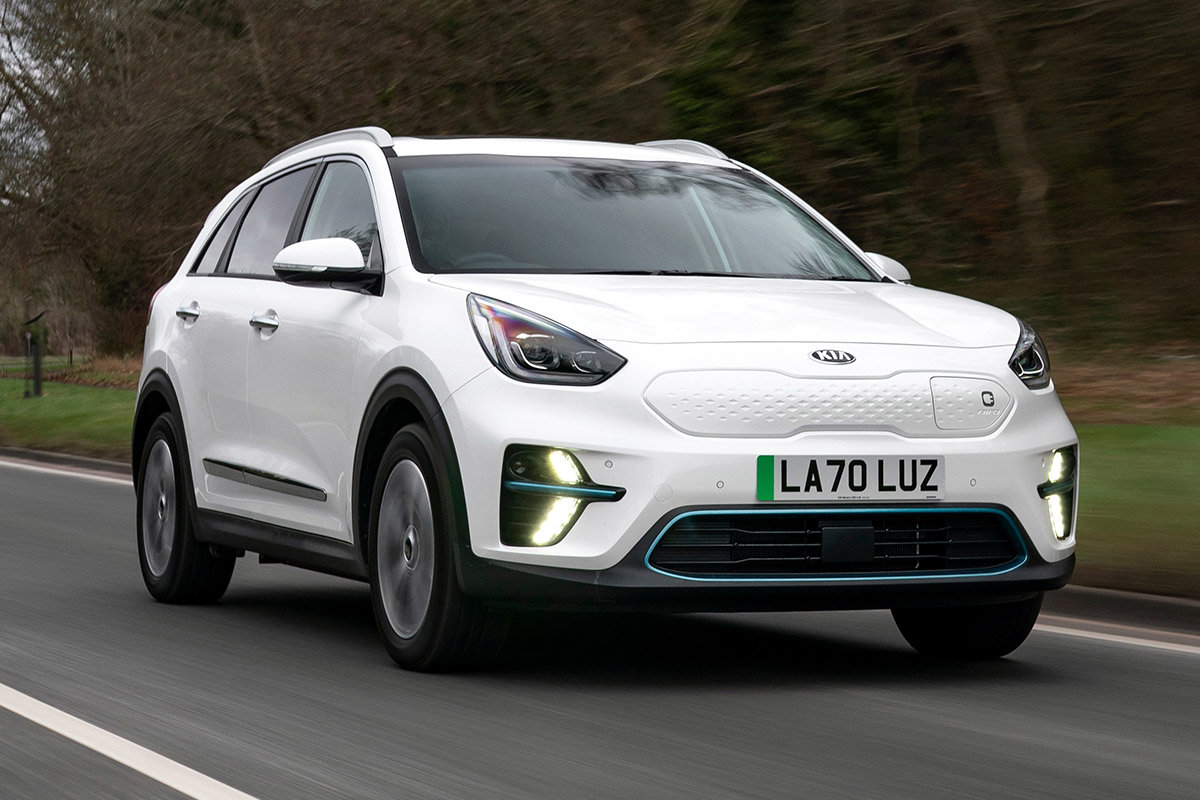
What is the Kia E-Niro?
Complete with a 64kWh or 39kWh battery, the Kie e-Niro is a front-wheel drive family hatchback (which has a hint of small SUV to its styling and ride height) that will easily cover 250 miles in real world use if you go for the big battery, or 150 miles if you get the smaller battery. Don’t confuse it with the plug-in hybrid or the full hybrid Niro models, because the e-Niro runs solely on electric power.
Cold weather and motorway mileage will see those real-world range estimates drop by as much as 25%, but in warmer weather and even with some time on artery roads, the e-Niro is a very efficient EV that will easily do more than four miles per kWh. For context, a Nissan Leaf typically does about 3.5 miles per kWh in similar everyday use, which is EV-speak for ‘the Kia does better ‘mpg’ than the Nissan’.
We have seen more than 300 miles per charge from the 64kWh Kia e-Niro during summer months (electric cars are at their most efficient when it’s warm due to the quirks of battery technology) so it’s certainly one of the longer range EVs on the market.
Plug into a normal home wallbox charger and the e-Niro takes less than 10 hours for a full charge if you have the bigger battery pack; the smaller battery 39kWh model will do the same in six hours. The CCS and Type 2 charging ports also allow for easy top-ups at public charging stations, with the peak rapid charge rate of 100kW delivering an 80% charge in less than 40 minutes for the 64kWh battery, and around 30 minutes for the 39kWh version.
Cables for charging at a Type 2 public charger and at a standard domestic home wall socket are provided, with the latter taking between 18 and 30 hours to fully charge the car depending on which battery you go for.

How practical is it?
You’ll have no problems transporting a couple of kids and the dog in the e-Niro. It’s roughly the same size as a Volkswagen Golf, but there’s enough boot space to take a chunky buggy or a big dog with ease.
The boot itself can swallow 451 litres of luggage, which is very good for this class and significantly bigger than the plug-in hybrid Niro’s 324-litre boot; the e Niro’s battery is mounted under the floor, which creates more storage space in the back. The boot floor also has a variable height, and there’s storage space for the charging cables beneath the main compartment. In short, it’s a very practical compact family car.
In the back seats, space isn’t overly generous, but there’s still more than enough for a pair of adults – or three at a squeeze – to sit comfortably. And the e-Niro’s elevated rear seats mean that buckling children into them is really easy.
Up front, there’s plenty of room for both driver and passenger, and between them you get a large covered bin in the floating centre console with pop-out cupholders within, which are really handy because it means you can choose between using this bin as storage or for your coffee – or both. Beneath the floating centre console there’s another huge bin, too, and there are plenty more useful storage slots and nooks besides.
What's it like to drive?
It’s no exaggeration to say that the Kia e-Niro is a delight to drive. The 204bhp, 64kWh version is faster than you’d ever imagine, with a 0-62mph of 7.5 seconds, and even in Normal drive mode, it leaps off the line and embarrasses most other cars, which is always good fun in such an unassuming hatchback. The more affordable mid-range model is hardly tardy, either, with 136hp and a 0-62mph time of 9.5 seconds.
The 204bhp electric motor has so much power and torque that it can have the front wheels spinning if you’re heavy-footed away from a standstill, but otherwise, it has plenty of grip and is a comfortable, stable, and enjoyable car to drive whether you’re on a fast motorway run or pootling through town.
The 134bhp model is just as good, if not better, for what it loses in outright performance, it gains in ease of driving, because it isn’t as easy to spin the wheels, so it’s less of a handful. And because its 39kWh battery is lighter, the e-Niro feels a little more agile, and the ride is a touch more comfortable.
Whichever version you go for, the steering is predictable, the regenerative braking is smooth and easy to judge (as well as easy to control via the steering wheel paddles) and refinement is outstanding.

Technology, equipment & infotainment
The Kia also benefits from a very comfortable, logically laid-out cabin. The post-facelift long-range model gets a great 10.25-inch colour touchscreen system as the focal point of the dash. The mid-range cars, as well as all pre-facelift examples, have an eight-inch touchscreen with the same features.
These include satnav, a digital radio, USB connections, Apple CarPlay and Android Auto. The system is quick to respond and easy to navigate, and you can also find charge points using the car’s satnav and set specific times that you want to charge the car, which makes it easy to take advantage of cheap overnight utility tariffs.
The infotainment systems in the BMW i3 and the Tesla Model 3 have better graphics quality, but the Kia’s system is well thought through, and works quickly and without hassle, so if you can live with the looks, it’s pretty easy to use.
Despite having only been launched at the start of 2019, the e-Niro was on the receiving end of a facelift along with the rest of the Niro range in 2020. Until then, there was only one equipment level available, and it got a roughly mid-range specification, with heated, electrically adjustable front seats, automatic lights and wipers, that eight-inch touchscreen, and 17-inch alloy wheels as standard. Oddly, though, you only got single-zone climate control, whereas the rest of the Niro range had dual-zone climate control as standard.
The 2020 facelift brought with it very little change externally, but the dashboard architecture was completely re-designed, to give a more upmarket feel.
At the same time, the range structure fell into line with the petrol Niro, following the contemporary Kia convention of grades known by numbers. The entry-level 2 was only available with the short-range battery and less powerful motor, while 3 and 4+ versions got the more potent, long-range powertrain as standard.
In terms of equipment, 2 came reasonably well equipped, with adaptive cruise control, automatic headlights and wipers, Android Auto, Apple CarPlay and, once again, single-zone climate control. 3 then added electrically adjustable, heated front seats, that larger touchscreen, and leather upholstery.
It was the 4+ that really pushed the boat out, however, with a kit list more akin to a luxury car. Ventilated front seats, heated outer rear seats, ambient lighting, front parking sensors, a JBL premium sound system with a subwoofer, LED headlights, and even a sunroof.
You can even get a heat pump in an E-Niro. This is a handy bit of kit to have as it generates more heat efficiently in winter, and therefore harms the e-Niro’s range less than a conventional heater. To get one, you’ll have to go for either the 4+ or First Edition model, but frankly, most EVs around this age don't even give you the option.

Kia e-Niro running costs
It’s hard to overstate just what tremendous value the e-Niro looks like on the used market. A glut of cars has pushed values down – and while that’s bad news for owners who’ve had their e-Niros from new, it’s good for those buying used, as it means good, solid examples can be had for bargain prices.
What’s more, compared with other electric cars, the e-Niro is one of the most efficient around, achieving impressive energy efficiency figures of around four miles per kWh (mpkWh).
What all those numbers mean in the real world is that running an e-Niro will make a significantly smaller dent in your electricity bill than a Volkswagen ID.3 or a Peugeot e-2008.
You could also save even more on running the e-Niro if you use cheaper, overnight tariffs, which is easy to do since there is a setting on the car’s screen to set the hours you’d like to charge and you can also control the timed charging (and pre-set the cabin temperate) via Kia’s phone app.
Servicing is required every 12 months or 10,000 miles, which is not great since many electric cars have much longer service intervals. At least there are fixed price plans available, and you can spread the cost into interest-free monthly instalments.

Kia e-Niro reliability
The e-Niro came with a seven-year warranty when it was new, which means even though it’s been out of production for four years, all but the very earliest examples should still be covered (assuming their mileage is below the 100,000-mile limit). You can’t say that for most cars, let alone most other EVs.
Having said that, Kia’s warranty cover is contingent upon the e-Niro having been serviced properly, so it’s important to check for a full and complete service history, and to ensure that maintenance has been performed to Kia’s standards, in order for the warranty to still be valid.
Will you even need that warranty cover, though? It seems unlikely, given how well the e-Niro tends to perform in reliability studies. The fact that it’s a regular fixture on private hire fleets bodes well, too – taxi drivers tend to choose cars with a good reputation for dependability.
What’s more, owners report that battery degradation on the e-Niro is almost non-existent, with some quoting certified battery states of health of 100 per cent even on cars that are several years old.
Some e-Niros can suffer from wear in the motor bearings, which results in a rattling sound that you can hear at low speeds. Kia is replacing affected motors under warranty – but it’s likely to be a costly job, so keep it in mind if you’re buying a car whose warranty has expired.
- The Kia e-Niro was in such demand that there was a waiting list of more than a year when it was first launched in late 2018, and initially offered only with a 64kWh battery and in high-spec First Edition trim. Buyers were paying more than list price for a used example of one of those first cars that came to the UK. These days, of course, that’s no longer the case, but it does mean that early examples are often no more affordable to buy than the later, post-facelift cars – which come with a better interior.
- Picking a trim in the e-Niro also means picking the battery. Entry-level 2 cars get the 39kWh battery, while 3 or 4+ both have the 64kWh battery. This is straightforward enough when you look at the equipment list, but it’s worth knowing, because there could be a discrepancy between the battery you want and certain bits of equipment.
- The Kia’s regenerative braking system offers three levels varying from barely noticeable to very strong, and they can be selected via the steering wheel. We enjoyed using the automatic setting, which still allows you to select how strong you want the brake regeneration to be but also modulates the braking as you approach a car in front. It sounds complicated, but you quickly get used to it and learn to trust and predict how the car is going to brake. You can even pull and hold the steering wheel paddle to bring the car to a complete halt, but this isn’t as intuitive as the full ‘one pedal’ driving mode in the Nissan Leaf.
- If you’re looking for the best value e-Niro: we’d point towards the long-range car, albeit in 3 trim. The bigger 64kWh battery transforms the e-Niro’s daily usability if you regularly do longer journeys, and with long range electric cars in such demand it’ll also hold its value much better when you come to sell it on or part-exchange. The 3 trim gets leather upholstery, electrically adjustable seats, keyless entry, reversing camera, 17-inch alloys and more, so it really does offer all the comfort and convenience you could want.
- If you simply want the lowest purchase price: well, you won’t necessarily find it by choosing the 39kWh Kia e-Niro 2, even though that’s the least desirable version. That’s because the 39kWh model wasn’t available at launch, which means the oldest e-Niros are 64kWh examples. Compounding this is the fact that most taxi drivers who chose an e-Niro took the big-battery model, which means the higher-mileage examples that dot the lower end of the market are all 64kWh models (and, given some of the super-low prices being asked, might even be worth a punt if you’re feeling brave).
- If you want the sportiest Kia e-Niro, of course it’s the 3 or 4+ long range cars that you should go for since they get 201bhp and thoroughly cheeky, almost hot-hatch-like pace. The Kia is also surprisingly good to drive on a decent road, thanks to its seamless power delivery and nicely weighted steering, but we’d add that it isn’t a hot hatch and doesn’t have the kind of vigour and involvement that you get in others. A Tesla Model 3 is more of a driver’s car if you can stretch to the higher asking price.
- If you want the most efficient Niro of all: go for one with a heat pump. This will help protect your range when the weather outside is frightful, as it’ll make heating your car more energy efficient. That means choosing a 4+ or a First Edition example. The added bonus is that these models come with heated seats, which will help matters as it’s more energy efficient to heat your body directly than it is to heat the air around you.


